
“We don’t need people who panic or fly into a fit of hysteria,” Oksana tells me, looking me straight in the eye.

It is a beautiful August afternoon. We are standing on the small balcony at the back of the Мурашкі kitchen in Kyiv were I work as a volunteer, watching teenagers stroll between the blocks of flats.
“Some time ago, a young foreigner with military training came to work for us. When the sirens went off, he panicked. We asked him to go home. There was no point.” She takes a sip of coffee from her cup. “Nor do we need anyone who spends hours in the cellar during the day whenever the alarm goes off. We need people working with us in the kitchen.”
I think of Oksana’s words the following morning, when an air-raid alert goes on for hours while we roll out dough, cut it into pieces and place them on baking trays. Through the open window come the repeated booms of Ukrainian air defence intercepting drones. We cannot see anything, but it is obvious that they are being shot down somewhere above us.
Some people glance upwards but most barely react. Nobody runs to the cellar. We simply carry on working.
Several days later, I walk across a footbridge over the Dnipro towards Trukhaniv Island. In the middle of the bridge, with the river far below me, I hear the short, rapid bursts of anti-aircraft fire. A thought flashes through my mind: What if Putin’s drones target bridges like this one? A counter-argument follows: Road bridges are surely a much more obvious strategic target. With thoughts like these, I try to reassure myself.
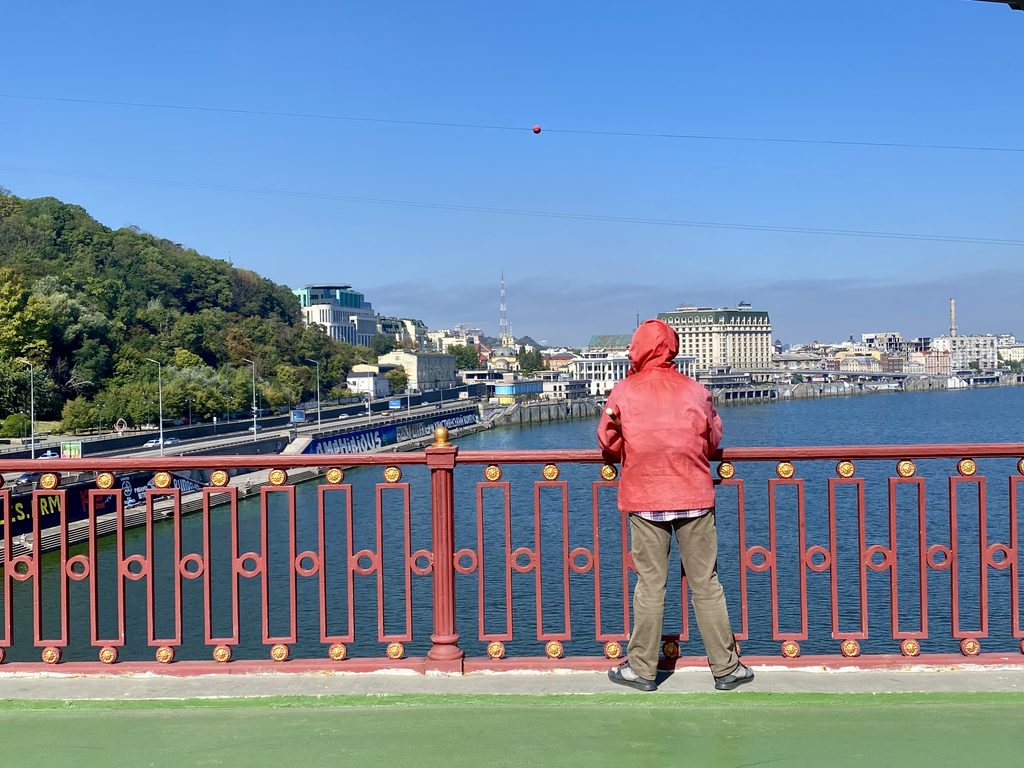
Today, back in safety, these moments seem almost surreal. If someone had told me a few years ago that one day I would be walking across a bridge in Kyiv while air defences were firing at drones overhead, I would not have believed them.
No one knows in advance how they will react to an air-raid siren. A siren is not simply a loud noise. It is a powerful stimulus that tells the body: danger is coming. Adrenaline is released, the heart rate rises, muscles tense. The siren does not tell you what will happen; it tells you that something might happen.
The safest response, of course, is to seek shelter whenever the alarm sounds. But if Ukrainians were to drop everything during the day—when air-raid alerts have become a regular part of life—and run to a shelter every time, the country would grind to a halt. People still have to work, food still has to be prepared, life has to continue.
I myself am by no means free from fear. I could feel fear in the pit of my stomach, a heavy, dull, gnawing sensation. When the sirens went off, something inside me tightened. I would reach for my phone and check the air-defence channels. Locations reportedly targeted by drones or missiles scrolled past on the screen, one after another, like items on a conveyor belt.
Hearing an air-raid siren yourself is psychologically very different from reading “Kyiv is under attack” in a news feed. The siren turns an abstract geopolitical reality into an immediate bodily experience. Suddenly, your nervous system is part of the story.
I am a little proud of myself that I did not allow fear to get the better of me.
A British expat living in Kyiv recently described the way Ukrainians have learned to cope with the constant threat. The siren, he wrote, no longer sounds like “the herald of the apocalypse”. When death falls from the sky repeatedly, the human brain recalculates its baseline for normality. Danger becomes almost like the weather.
He drew a parallel with the Blitz against Britain in 1940. The assumption behind the German bombing campaign was that sustained attacks on civilians would eventually break their will. Yet people continued to live their lives. They cleaned up the glass, opened their shops and went to work.
That is what resilience looks like in Kyiv too. Resilience is not the absence of fear or some romanticised stoicism. It is the stubborn decision to carry on with ordinary life even when extraordinary things are happening overhead.
In Kyiv, most people I observed seemed remarkably calm when the alarm sounded. But calm behaviour does not necessarily mean an absence of fear. It may mean that people have learned to function despite it.
Of course, years of living with danger take their toll. A nervous system exposed to constant threats can remain in a state of heightened vigilance. People may sleep badly, startle more easily at sudden noises, or find it difficult to relax even when there is no alarm. These are not necessarily signs of PTSD; they can also be understandable consequences of prolonged exposure to danger.
There is a lot to learn from the way Ukrainians live with fear. Perhaps it can be reduced to a simple sentence: I am frightened, but I can still carry on. And perhaps that is one of the keys to understanding how civilians endure a prolonged war.