

In an unassuming pavilion in front of a prefabricated housing estate in Troieshchyna, a north-eastern district of Kyiv on the left bank of the Dnipro, a small glass door bears the inscription “Мурашки” (Ants). Below it is a colourful picture of an ant carrying an enormous sack of food on its back.

The Kitchen Ants are a volunteer organisation founded after Putin’s full-scale invasion of Ukraine in February 2022. What began as a civilian kitchen helping refugees and displaced people has evolved into an operation supporting soldiers on the front line, specifically units in exposed positions where normal logistical support is no longer possible. The Kitchen Ants prepare lightweight, dehydrated field rations that can be dropped by drone. Add hot water, and they provide a warm, nutritious meal.
Before my trip to Kyiv, I had decided that, apart from taking a Ukrainian language course, I wanted to do something useful. But would I have enough energy to help?
Perhaps, I thought, I would suffer from chronic lack of sleep and spend my days wandering around like a zombie. That fear did not come true. In the hotel shelter, I found a sort of lounger where I could sleep. I was very grateful for it.
The Kitchen Ants are a long way from the city centre, where my hotel was located. There is no underground or train connection – only buses. The journey takes about an hour. My Ukrainian teacher was slightly concerned when I told her where I was going.
“We hardly ever go to Troieshchyna,” she said. “It’s more dangerous there.”
Indeed, the left bank of the Dnipro has been targeted more frequently by Russian attacks than the right bank. Perhaps the difference evens out over time; in recent weeks and months, attacks on all parts of the Ukrainian capital have become a constant feature of daily life.
I first visited the Kitchen Ants with my sons. When we opened the door with the picture of the ant, we were greeted enthusiastically. “Welcome!” called Ben, a young American. Perhaps the box of sweets from Prague that I had brought as a present contributed to the warm welcome.
Before we knew it, we had put on aprons, plastic caps and rubber gloves and were sitting at a table alongside a friendly German woman, coring and halving apples.
We could not stay long, but even that first visit left a lasting impression. The name was spot on. In the kitchen, everyone was working with ant-like diligence: Ukrainian women of all ages and international volunteers from a whole range of countries – the UK, the US, France, Germany, Italy, Sweden, Romania, New Zealand, Canada … Not just young people, as one might expect, but older people like me.
The following week, I began my daily work with the Kitchen Ants. They work at weekends, too. There is no break.


Dough is kneaded, rolled out, cut into pieces and baked into crispy crackers. Fruit is cut into pieces and dried in ovens. Ingredients are carefully weighed and packed into small parcels. Everything is then delivered to the front. The wall next to the entrance is covered with the blue-and-yellow flags of the battalions we supply.
After several hours of working on my feet, my back begins to ache. I rest for a moment and do a few stretches. Then it is back to work. The next batch is waiting.
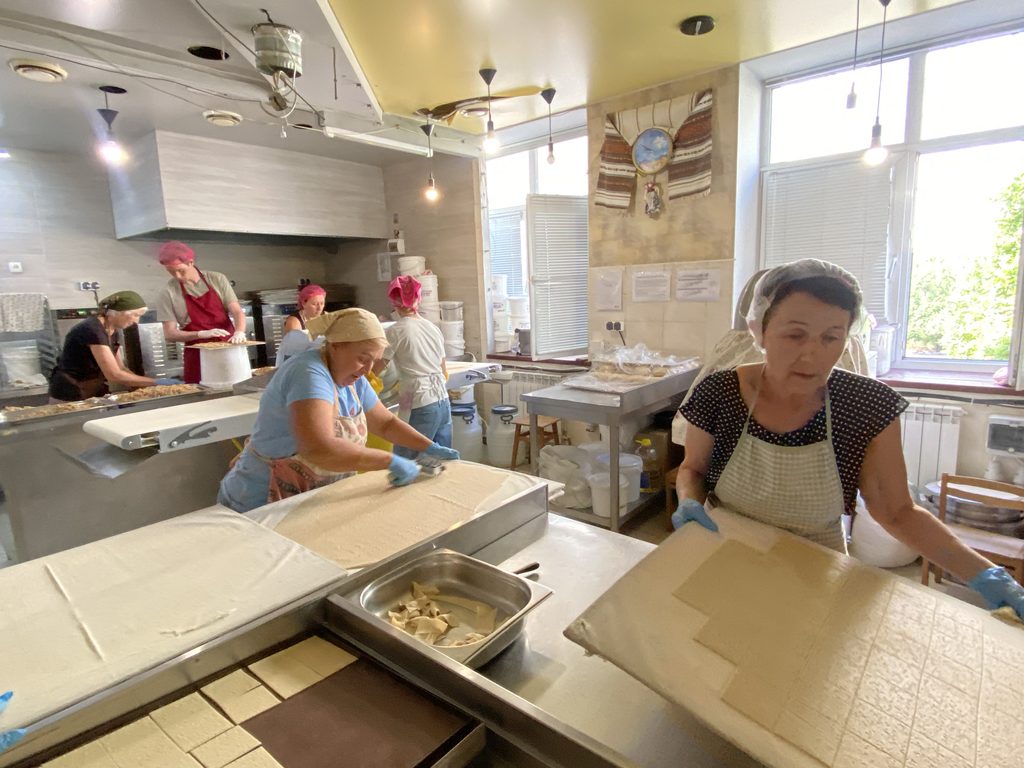
Everyone works with intense concentration. Where do these Ukrainian women get their energy from? It seems endless. With admirable efficiency and determination, they work without a break.
Even when the sirens wail.
When the European politicians left after Independence Day, Putin started to launch continuous attacks. No sooner has one attack ended than another begins.
“Did you hear that?” Ben asks as a loud bang echoes through the open window. The air defence has shot down a drone.
It is frightening. But if everyone ran to a shelter the moment the sirens sounded, the work would come to a standstill. We look up briefly and then carry on.
Carrying on, not giving up – that is the essence of Ukrainian resilience.
When I walk past the blocks of flats on my way to the bus stop at the end of the day, I feel a sense of contentment. I have made a contribution, albeit a very small one, to the defence and freedom of this country and its people.
As the day of my departure draws nearer, I begin to feel wistful. Before the journey, I had imagined I would be counting down the days until I could go home again, back to safety.
Now I would love to stay.

That is exactly what I say in a short farewell speech I have prepared in Ukrainian for the kitchen staff. I put on my vyshyvanka, my embroidered blouse, and take the sheet of paper from my pocket.
These women – whose husbands, sons and fathers are fighting the aggressor, men who may no longer even be alive – listen to me. These women, who are doing such incredible work here, are moved.
“Thank you for having the courage to come and help us,” they say. “Thank you for showing us that we are not alone.” But it is not I, who can return to the safety of my European home, who deserve admiration. They do.
Back in Prague, I often think of the Kitchen Ants. A harsh winter awaits them. I can scarcely imagine how they managed to get through the last one.
But there is one thing I already know: I will come back.
***
Support the Kitchen Ants
You can support the Kitchen Ants with a financial contribution. After almost five years of war, everything has become more expensive and more difficult, and the organisation will soon have to find a new home.
https://send.monobank.ua/jar/5QExNFCzBU
Every contribution helps. Thank you.
https://volunteeringukraine.com/en/volunteer-opportunities/kyiv-kitchen-ants